Artificial Intelligence, commonly known as AI, has become one of the most talked-about technologies in recent years. Whether you are using a smartphone, browsing the internet, watching videos, or studying online, you are already interacting with AI systems in some way. AI for beginners from personalized recommendations on platforms like YouTube to smart assistants and automated chatbots, AI is shaping the digital experience for millions of users worldwide. Best Remote Jobs for Indians in 2027
Despite its growing presence, many beginners still struggle to understand what an AI system actually is. AI Tools The concept may sound complex, but in reality, it can be explained in simple terms. An AI system is designed to simulate human intelligence, allowing machines to think, learn, and make decisions based on data.
In 2026, AI is no longer limited to large tech companies or developers. AI blogging Students, freelancers, bloggers, and even beginners are using AI tools to improve productivity and simplify their work. This makes it essential for everyone to understand how AI systems work and how they can be used effectively.
What Is an AI System
An AI system, or Artificial Intelligence system, is a computer-based system that is capable of performing tasks that typically require human intelligence.AI Innovation These tasks include understanding language, recognizing images, solving problems, and making decisions.
To understand this better, think about how streaming platforms recommend content. When you watch videos online, the system analyzes your behavior and suggests similar content. This is not random—it is powered by AI.
Another example is search engines. When you type a query, the system quickly processes billions of data points and shows the most relevant results. AI Tools This level of efficiency is only possible because of AI.
The core purpose of an AI system includes:
- Understanding and processing large amounts of data
- Identifying patterns and trends
- Making predictions or decisions
- Continuously improving through learning
Unlike traditional software, which follows fixed instructions, AI systems are dynamic. They evolve over time and become more accurate as they receive more data.
How Does an AI System Work?
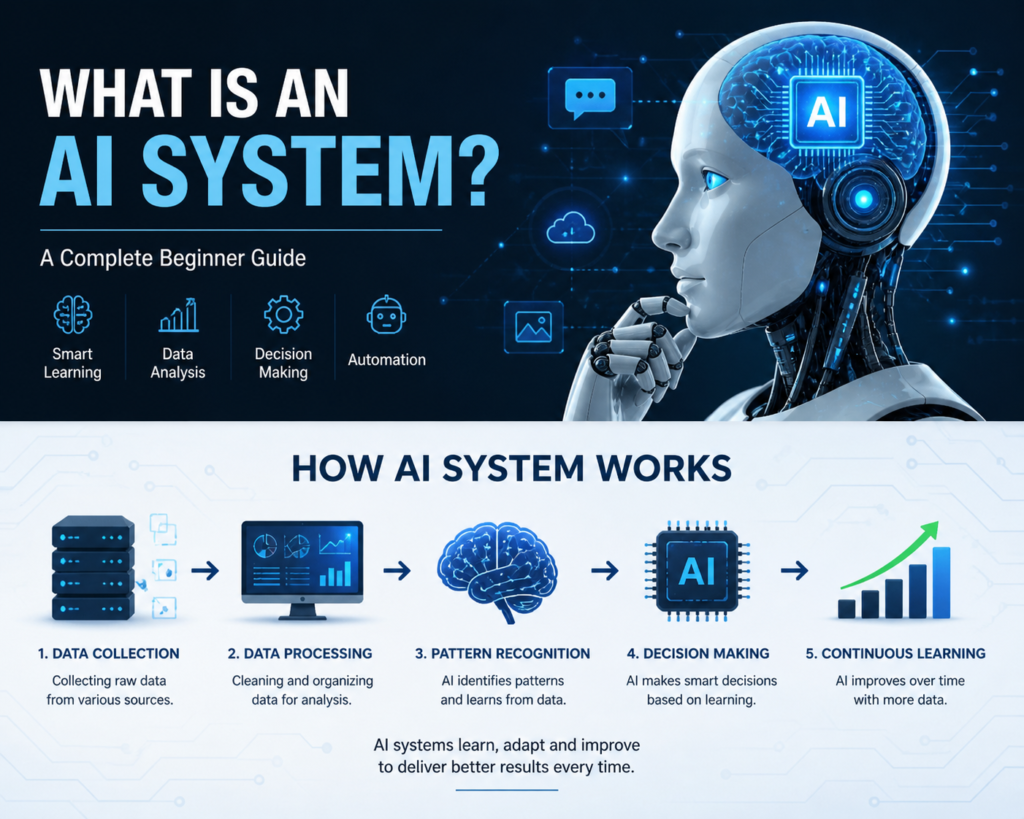
Understanding how an AI system works is important for beginners who want to use it effectively. AI Tools While the technical details can be complex, the basic process can be explained in a few simple steps.
The first step is data collection. AI systems rely heavily on data, which can come in various forms such as text, images, audio, or numerical values. The quality and quantity of data play a crucial role in how well the system performs. Best Trading Strategies for Beginners in India (2026)
Once the data is collected, the system processes it using algorithms. These algorithms are designed to identify patterns within the data. AI tools for bloggers This stage is often referred to as machine learning.
During the training phase, the AI system learns from examples. For instance, if it is trained to recognize faces, it will be shown thousands of images with labels. Over time, it learns the differences between various features.
After training, the system enters the prediction phase. When new data is introduced, the AI uses its learned knowledge to make decisions or predictions.
The key stages of AI working include:
- Data collection and preparation
- Data analysis and processing
- Pattern recognition
- Decision making and improvement
This continuous cycle allows AI systems to improve accuracy and performance over time.
Uses of AI Systems for Students
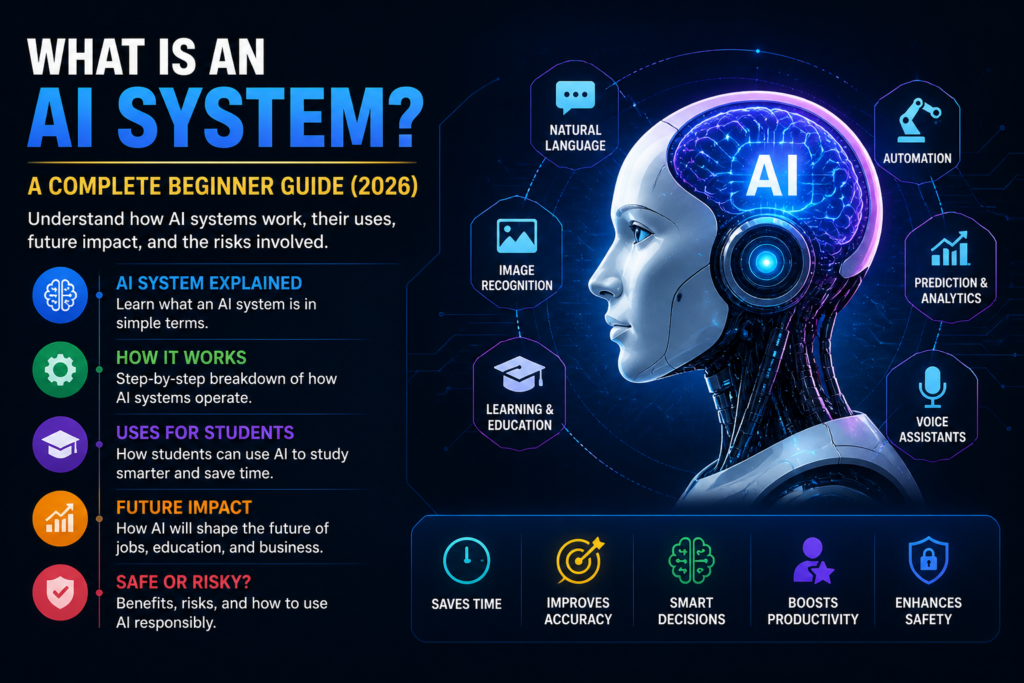
AI systems have become extremely useful for students, especially in the modern education system where digital learning is becoming more common. With the help of AI, students can save time, improve their understanding, and enhance their productivity.
One of the most common uses of AI for students is content generation. Students can create notes, summaries, and explanations quickly. This is particularly helpful when dealing with complex topics.
AI also plays a major role in personalized learning. Instead of following a fixed learning method, students can receive customized suggestions based on their strengths and weaknesses.
Some practical uses of AI for students include:
- Writing assignments and essays
- Generating study notes and summaries
- Learning new concepts through simplified explanations
- Improving grammar and communication skills
- Creating presentations and project content
For example, a student struggling with English writing can use AI tools to improve sentence structure and vocabulary. Similarly, someone preparing for exams can use AI to revise topics efficiently.
However, it is important to use AI as a support tool rather than relying on it completely. Real learning happens when students actively engage with the subject.
Future Impact of AI Systems
The future of AI systems is expected to be transformative. As technology continues to evolve, AI will play an even bigger role in shaping industries and everyday life.
In the healthcare sector, AI will assist doctors in diagnosing diseases more accurately. In education, AI-powered systems will provide personalized learning experiences for students. Businesses will use AI to automate processes and improve decision-making.
Some key future impacts of AI include:
- Advanced automation in industries
- Creation of new job roles
- Improved efficiency in business operations
- Enhanced user experience in digital platforms
- Development of intelligent machines and robotics
While AI may replace some repetitive jobs, it will also create opportunities in new areas such as data science, AI development, and digital marketing.
For beginners, this means that learning AI basics today can provide long-term benefits in the future.
Is AI Safe or Risky?
AI systems offer many advantages, but they also come with certain risks. Understanding both sides is important for responsible usage.
Advantages of AI:
AI can perform tasks faster and more efficiently than humans. It reduces manual effort and increases productivity. It can also provide accurate results based on data analysis.
Risks of AI:
One of the major concerns is data privacy. AI systems often rely on personal data, which can be misused if not handled properly. Another issue is over-dependence, where users rely too much on AI instead of developing their own skills.
There is also the risk of misinformation. AI can generate fake content, including images and videos, which can spread false information.
To ensure safe usage, it is important to:
- Use trusted platforms
- Avoid sharing sensitive data
- Verify information before using it
- Maintain a balance between AI and human skills
When used responsibly, AI can be a powerful and safe tool.
Conclusion
Artificial Intelligence systems are becoming an essential part of modern life. They are transforming how we learn, work, and interact with technology. For beginners and students, AI offers a valuable opportunity to improve productivity and develop new skills.
Understanding how AI works and using it effectively can provide a significant advantage in today’s digital world. However, it is important to remember that AI is a tool designed to assist, not replace human intelligence.
By combining your skills with the power of AI, you can achieve better results and stay ahead in the evolving technological landscape.
“AI is not the future anymore—it is the present, and those who learn it today will lead tomorrow.”